Wine cooler
One Zone of a Sub-Zero Wine Cooler Running Warm
In the owner's words
The upper zone holds where I set it, but the lower one keeps reading several degrees warmer, and the reds in there feel noticeably warmer than they should.
Short answerWhen only one zone of a Sub-Zero wine cabinet runs warm, the machinery is plainly making cold, because the other zone proves it. What we usually find is cold air not reaching the warm zone: bottles against the back wall, one of the unit's fans stopped, or a door seal leaking room air. Sub-Zero Appliance Repair Seattle, (206) 339-4211, follows that air path first.
Signed
- Technician
- Bjorn Aaltonen
- Bench time
- 15 years in the trade
- Title
- Refrigeration technician — wine storage and dual zones
- Carries
- EPA 608 certified
- Dated
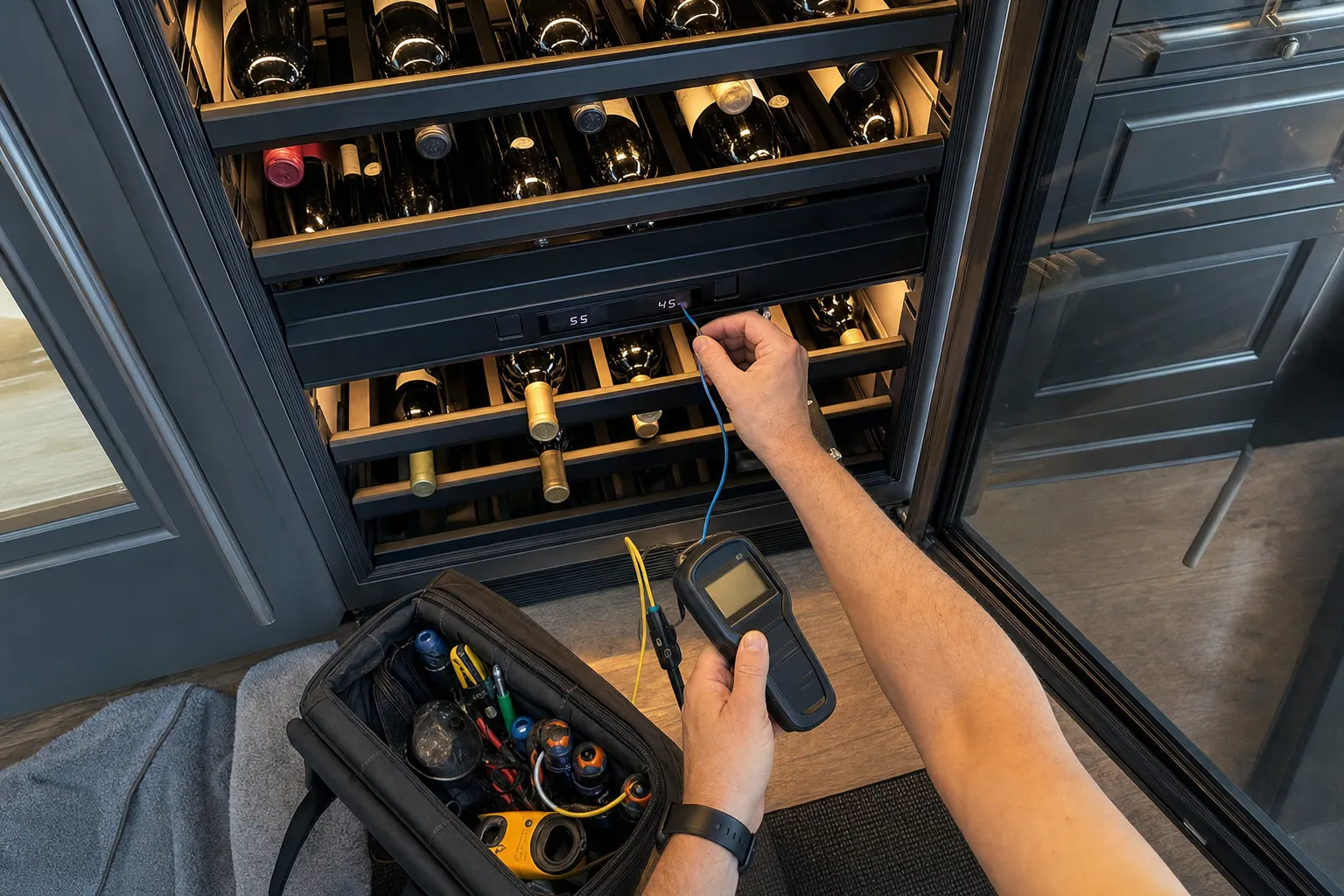
- Zone display
- Meter
Pattern Ledger
One Wine Zone Running Warm: how it usually goes
- Most often Bottles or a rack blocking that zone's air
-
Gives itself away by Bottles pressed hard against the back wall, and the zone recovering within a day once they are pulled forward
Price band none set for this work — quoted after the diagnosis
- Sometimes One of the unit's fans stopped
-
Gives itself away by No air moving in the warm zone, while the other zone keeps its set point as usual
Price band Evaporator or condenser fan motor$330–$690
- Rarely A temperature sensor misreading
-
Gives itself away by A thermometer on the middle rack disagrees with the display by the same margin, steadily, day after day
Price band Defrost heater, thermostat or sensor$260–$690
Telling these three apart is what the $89 visit is for. Sub-Zero Appliance Repair Seattle · (206) 339-4211
The working zone is evidence
A zone that holds its setting shows the compressor and condenser are doing their job. The search moves to whatever carries cold into the warm zone: the air path, the fan driving it, the seal keeping it in, and the sensor reporting it. Sub-Zero’s list of causes for a warm wine unit names one of several fans, a sensor or thermostat, and a door seal.
What we usually find
Most often, bottles pushed into the back of the rack where the air has to pass. After that, one of the fans, worn or stopped. A damaged gasket keeps the warmth near the door, sometimes with a little fog on the glass. A misreading sensor comes last, tested against a meter in the zone before anything is replaced.
What you can check safely
- Pull the bottles in the warm zone forward so none of them touch the back wall or cover a vent, then leave the door shut for a day.
- Check the set point of that zone on the display; each zone takes its own setting, and one can be changed without the other.
- Run a finger around that zone's door gasket and look for a tear, a flattened stretch or a cork caught in the fold.
- If the cabinet is new or was just switched back on, allow 24 hours, since Sub-Zero notes a new unit may cool one zone before the other.
Owner checks end there. Sealed tubing, wiring behind the grille and anything held by screws belongs on a service call — Sub-Zero Appliance Repair Seattle, (206) 339-4211.
Questions owners ask about this
Why would one zone warm up if the cabinet has only one door?
The zones share the cabinet, but the cold is moved to each by air, and anything that blocks or stops that air shows up in one zone first. A crowded back wall, a stopped fan or a seal letting room air in along one stretch of the door can all do it.
Could the display simply be wrong?
It can. Put a thermometer in a glass of water on the middle rack of the warm zone and read it a day later. If it matches the display, the zone really is warm. If it keeps disagreeing by the same amount, the sensor becomes the suspect.
Is it worth fixing a zone I barely use?
Usually yes, because the cause rarely stays put: a failing fan or a leaking seal makes the rest of the cabinet work harder too. Sub-Zero Appliance Repair Seattle, (206) 339-4211, finds which part is at fault on an $89 service call, and the price is written down before anything is replaced.