Ice maker and ice machine
Sub-Zero Making Ice, but Far Too Slowly
In the owner's words
It still makes ice, but the bin never seems to fill. We run out every weekend now, and it used to keep up with everything we asked of it.
Short answerA Sub-Zero ice maker that still works but falls behind is usually getting too little water on each fill, or freezing it in a freezer that runs warm. Sub-Zero Appliance Repair Seattle, (206) 339-4211, measures its output against what the manufacturer says to expect before chasing any part.
Signed
- Technician
- Marta Fennimore
- Bench time
- 12 years in the trade
- Title
- Refrigeration technician — ice systems and water supply
- Carries
- EPA 608 certified
- Dated
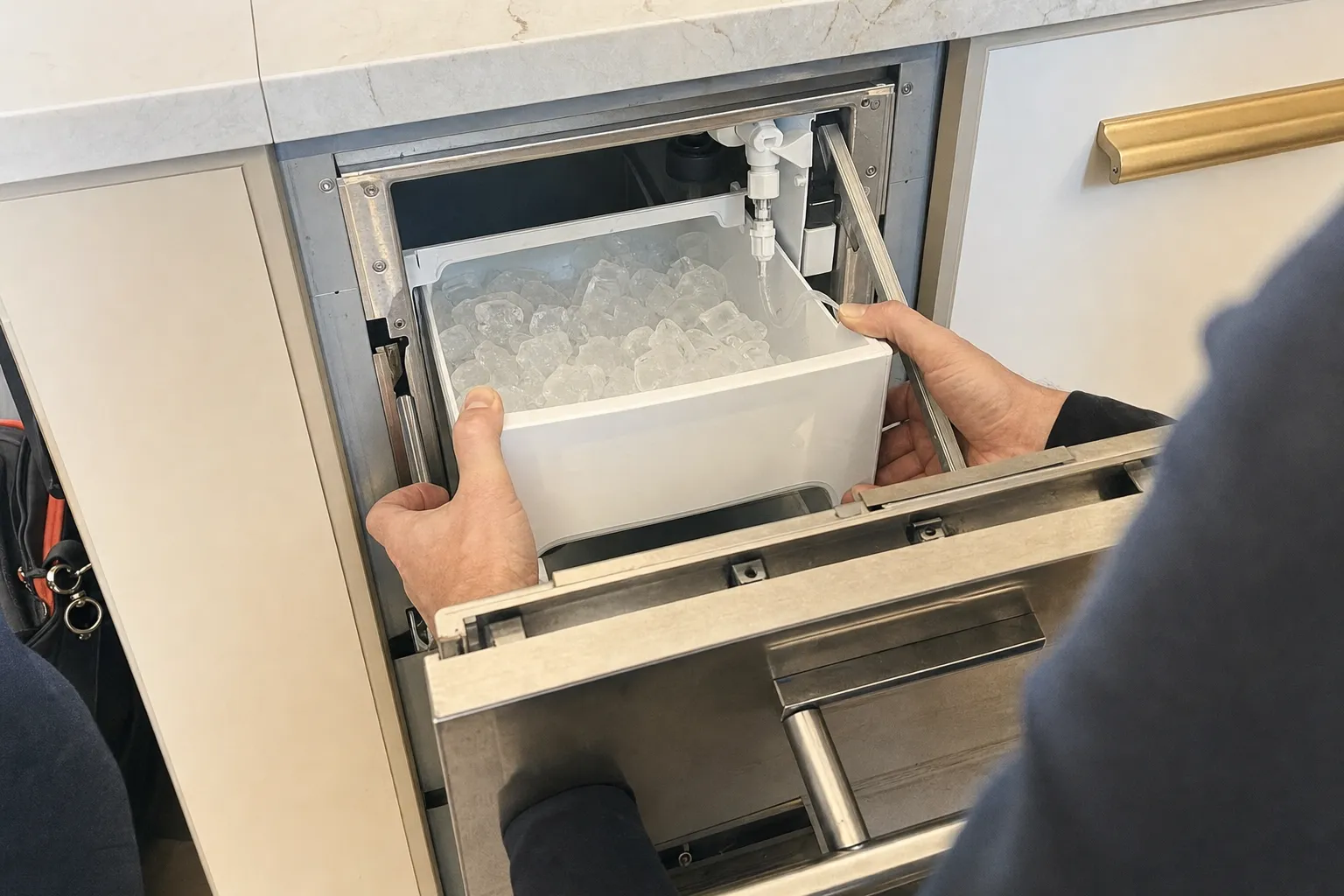
- Fill fitting
- Ice bin
- Drawer front
Pattern Ledger
Ice Coming Too Slowly: how it usually goes
- Most often Restricted water: tired filter, part-closed valve or pinched line
-
Gives itself away by Cubes come out small and thin as well as few
Price band Ice maker, water valve or supply line$270–$750
- Sometimes Freezer running warm: matted condenser or a slowing fan
-
Gives itself away by The freezer reads above 5°F on a thermometer, and ice cream is softer than it used to be
Price band Evaporator or condenser fan motor$330–$690
- Rarely Inlet valve opening weakly on each fill
-
Gives itself away by Pressure fine and filter fresh, yet every fill looks short and the cubes stay undersized
Price band Ice maker, water valve or supply line$270–$750
Telling these three apart is what the $89 visit is for. Sub-Zero Appliance Repair Seattle · (206) 339-4211
Slow compared with what?
Owners judge an ice maker against memory, and memory is generous. Sub-Zero publishes an average for its in-unit ice makers, so a slow cabinet can be measured: empty the bin in the evening and see what has dropped by morning.
What slows an ice maker down
Two things set the pace: how much water reaches the mold on each fill, and how fast the freezer turns it solid. A spent cartridge, a supply valve never fully opened, or a line crushed behind the cabinet cuts the fill. A freezer drifting above its set point stretches every freeze. The ice maker module is seldom the slow part.
Undercounter ice machines
A separate undercounter machine stores its ice in its own cabinet, and Sub-Zero notes that warm rooms and direct sunlight melt that ice quickly, which can pass for slow production.
What you can check safely
- Set the freezer to 0°F, the setting Sub-Zero recommends; the manufacturer treats anything above 5°F as too warm for ice.
- Note when the water filter was last changed, and replace it with a genuine cartridge if it is overdue.
- Look through the grille for lint matting the condenser, which slows the freezer.
- Make sure the supply valve feeding the refrigerator is fully open, not just cracked.
Owner checks end there. Sealed tubing, wiring behind the grille and anything held by screws belongs on a service call — Sub-Zero Appliance Repair Seattle, (206) 339-4211.
Questions owners ask about this
How much ice should a built-in Sub-Zero make?
Sub-Zero says its in-unit ice makers produce eight cubes every two to three hours on average, and an empty bin can take one to two days to fill. If yours falls well short of that with the freezer holding 0°F, call Sub-Zero Appliance Repair Seattle on (206) 339-4211.
Is there a setting that makes more ice?
On Classic (BI) and Designer models, Max Ice raises production for a while, and Sub-Zero says it is the only feature that changes output. It cannot cure a restriction: an ice maker short of water still makes small cubes. Treat Max Ice as a stopgap before a gathering, not as a repair.
Why does the ice run out at weekends but seem fine midweek?
Because the pace is fixed. Standard production cannot be adjusted apart from Max Ice, so a busy weekend empties the bin faster than it refills. A bin that stays low through quiet weekdays too, with the freezer at temperature, is the pattern worth diagnosing.