Refrigerator Repair
Sub-Zero Fridge Warm but Freezer Cold: What It Actually Means
On a dual-compressor Sub-Zero, a warm fresh-food side with a working freezer almost never means the compressor. Here is what it usually is, and what it costs to put right.
Reported by
Dean Halvorsen
Refrigeration technician — sealed systems and airflow · 19 years in the trade
- EPA 608 certified
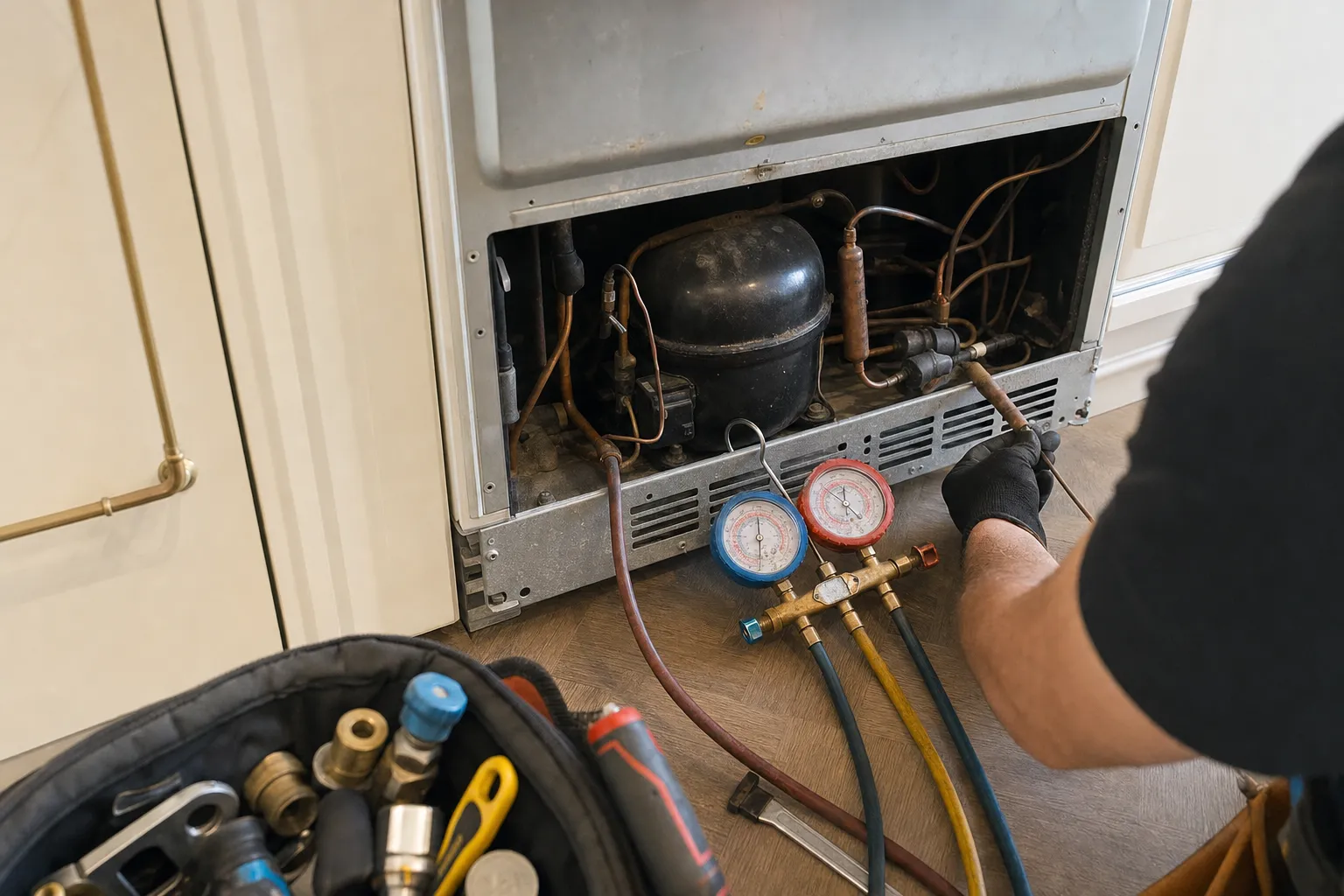
If the fresh-food compartment has drifted up to 50°F while the freezer is still holding at 0°F, the instinct is to assume the compressor has gone. On a built-in Sub-Zero that is almost never the answer — and the distinction matters, because one of those is a routine repair and the other is a much larger conversation.
Why the two sides fail independently
Built-in Sub-Zero combination units — the classic side-by-sides and over-and-unders among them — run two separate refrigeration systems, one for the freezer and one for the fresh-food compartment. Each has its own compressor and its own evaporator, and the service manual for the 600 series diagnoses them separately, down to separate error codes for each compressor.
That design is the reason this symptom is so common. A fault on the fresh-food circuit has no effect at all on the freezer, so you get a unit that looks half broken. It also means the diagnosis is narrower than it first appears: whatever is wrong is on one circuit, and the working side proves the other half of the machine is fine.
The three faults that cause it
In rough order of how often we find them on Seattle calls:
- Evaporator fan motor failure. The compartment is being cooled, but nothing is moving that cold air into the cabinet. Often audible — or rather, the absence of the usual soft airflow is audible.
- A frosted-over fresh-food evaporator. On the classic built-ins the defrost heater belongs to the freezer; the fresh-food side clears its evaporator in the off-cycle. A door held ajar by a shelf item, a stopped fan or a sensor misreading the coil can let frost sheet over it until air cannot pass. Symptoms come and go, which is what makes it confusing.
- Control board or thermistor drift. The unit thinks the compartment is at temperature and stops calling for cooling.
A sealed-system failure — an actual refrigerant leak or compressor problem on the fresh-food circuit — is a distant fourth. It happens, but it is not where a competent diagnosis starts.
What you can check before calling
Two things are worth doing yourself, and both take a minute.
Listen at the fresh-food compartment with the door open and the light switch held down. You should hear the evaporator fan running. Silence on that side while the freezer is clearly working points hard at fault one.
Look at the rear interior wall for frost or ice. A heavy, even coat is a sign the evaporator has iced over, usually because warm air got in or the fan stopped moving it. A light film is normal.
What is not worth doing: unplugging the unit for a few hours to “reset” it. It does temporarily improve an iced evaporator by melting the ice, which then masks the symptom for a day and makes the diagnosis harder when someone does come out.
What it costs and how long it takes
An evaporator fan motor or a sensor is a short repair once the part is in hand. A part made for one model family is ordered to that model, and the fitting is booked as a second visit. A control board follows the same pattern.
The number that matters up front is the service call: $89, flat, covering the full assessment, and credited in full against the total if you go ahead with the repair. You get the price before anything is opened up, which on a panel-ready installation matters — pulling an integrated column out of cabinetry is not something to be casual about.
If the diagnosis does come back as a sealed-system failure on the fresh-food circuit, we will tell you plainly whether it is economic to repair, and show you the readings the judgement rests on.
Questions that come up next
Can I keep using the freezer while the fridge side is warm?
Yes. On dual-compressor models the two sides are independent, so the freezer stays safe to use. Move anything perishable out of the fresh-food side while you wait.
Is this worth repairing on a 15-year-old unit?
Usually yes. An evaporator fan or a failed sensor is a repair measured in hundreds of dollars, against a replacement built-in that runs into five figures before the cabinetry work.